


Roles
Software Engineer/
Technical Designer
Team Size
5
Tools
Unreal Engine 5
UE C++
Blueprints
Visual Studio
Perforce
Production Time
May 2026 - August 2026
Genre
FPV Drone Milsim
Platform
Windows
The MCO FamilyZone is a Family Entertainment Center for Orlando International Airport created by M3D Technologies. Using real-time trackerless motion capture to track movement, the games are 1-2 minute aviation themed experiences. My role required architecting the gesture system to recognize certain movements as triggers for an assortment of gameplay features and the kiosk architecture.

The team at the Family Zone's grand opening at Orlando International Airport's Terminal A
the different games as part of the new MCO Family Zone at Orlando International Airport, Terminal A.
Gesture System
Challenge
Cole Engineering required a high-engagement, "pick-up-and-play" demo for the IITSEC 2025 show floor. The objective was to create a gameplay loop that demonstrated the high-fidelity flight physics of the Switchblade Drone while remaining accessible enough for a non-gamer to complete in 60-90 seconds.
Solution (The Pitch)
I proposed and architected a Time Trial Obstacle Course. This mode challenged users to navigate a tactical flight path while engaging targets, providing a clear beginning, middle, and end to the user experience. By focusing on a "Goldilocks" difficulty curve, the mode ensured that attendees felt the thrill of the simulation without the frustration of steep learning curves.
Technical Implementation
-
State Machine Logic: Designed and implemented the core game mode lifecycle—handling everything from pre-countdown initialization to real-time objective tracking and end-of-session data reporting.
-
Dynamic Feedback Systems: Developed a modular UI suite including a precision timer, objective counters (obstacles/targets), and a performance-based final grading system.
-
Performance Optimization: Ensured the game mode logic maintained a stable frame rate for a smooth attendee experience, utilizing event-driven triggers rather than expensive per-frame checks.
Kiosk Architecture
Challenge
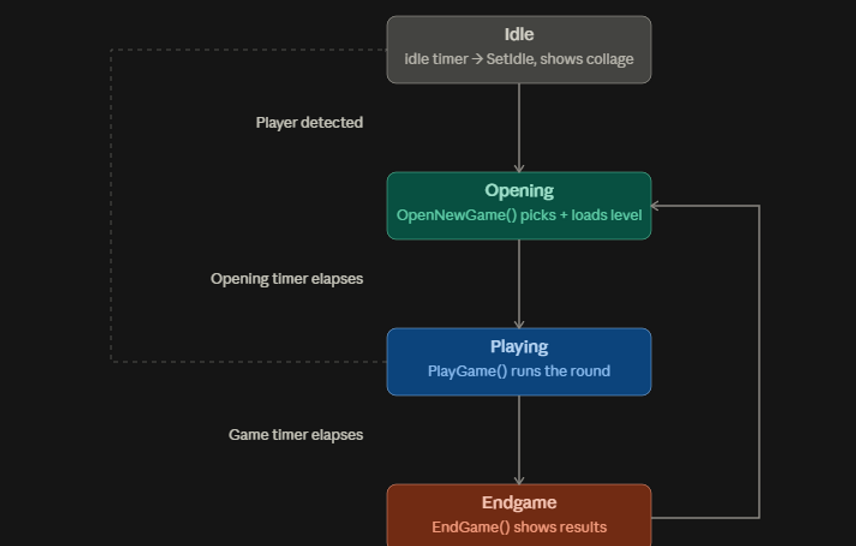
The project was initiated from an early-stage prototype that relied on expensive per-frame logic (Tick-dependent) and hard-coded references. As the scope expanded for the IITSEC 2025 showcase, the lack of a data-driven architecture led to significant performance bottlenecks, resulting in an inconsistent frame rate that threatened the stability of the demo.
Key Takeaways
While this project had a short timeline, given this was my first exposure on a military training application and the fact that I had the opportunity to work with and learn from some very talented senior developers, I learned some invaluable lessons such as in regards to software development and project timelines:
1.Favor Composition Over Inheritance
-
Weapons, characters, vehicles = composition-based systems, not class trees.
2. Centralize Data,,
-
WeaponData → one place.
-
CharacterStats → one place.
-
Spread-out data = bugs and sync issues.
3. Use Explicit Ownership,,
-
Every piece of data should have one owner.
-
No ambiguity whatsoever.
4. Avoid Circular Dependencies,,
-
Subsystem depends on weapon → weapon depends on subsystem → character depends on weapon → etc.
-
BAD.
5. Create Debug Tools,,
-
Console commands, drawers, gizmos, logs.
Conclusion
My time with Cole Engineering on the Switchblade Drone project was a series of pivotal "firsts" in my career: my first professional contract in the military simulation space, my first time delivering a product for a major international stage like IITSEC 2025, and my first time receiving a paycheck for doing what I love.
Beyond the technical milestones, the most valuable part of this journey was the opportunity to work alongside and learn from hardened industry veterans and senior software engineers. Refactoring a prototype into a performant, event-driven system within a strict two-month window was a massive undertaking. What our team accomplished in such a condensed timeline was nothing short of a miracle. I am incredibly proud of the modular framework we built and the successful public showcase we delivered, and I am eager to carry these lessons into my next role.